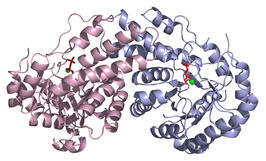


Target identification is important for modern drug discovery. With the advances in the development of molecular docking, potential binding proteins may be discovered by docking a small molecule to a repository of proteins with the 3D structures. Now what docking means? It is a method which predicts the preferred orientation of one molecule to the second when bound to each other to form a stable complex. Knowledge of preferred orientation in turn may be used to predict the strength of association or binding affinity betwene two molecules using scoring functions.
To complete this task, a reverse docking program and a dug target database with 3D are necessary. A web server, TarFisDock (Target Fishing Docking) has been developed, which has been widely used by others. Recently, a protein target database or Potential Drug Database (PDTD) has been constructed and have integrated PDTD with TarFisDock. This combination aims to assist target identification and validation.
In short, PDTD is a web-accessible protein database for in silico target identification. It currently contains more than 1100 protein entries with 3D structures presented in the Protein Data bank. The data are extracted from literature and several online databases such as TTD, DrugBank and Thomson Pharma. The database covers diverse information of more than 830 known or potential drug targets, including protein and active sites structures in both PDB and mol2 formats, related disease and biological functions as well as associated regulating pathway. Each target is categorized by both nosology and biochemical function. PDTD supports keyword search function, such as PDB-ID, target name, , and disease name. Data set generated by PDTD can be viewed with the plug-in of molecular visualization tools and also can be downloaded for free. Remarkably, PDTD is specially designed for target identification. In conjugation with TarFisDock, PDTD can be used to identify binding protein for small molecules. The results can be downloaded in the form mol2 file with the binding pose of the probe compound and a list of potential binding targets according to their ranking scores.
Below are the statistics of the (i) Distribution of targets by biochemical criteria and (ii) distribution of targets in therapeutics areas


No comments:
Post a Comment